Call centers are under more pressure than ever. Customers expect instant answers on every channel, leaders expect leaner operations, and agents are juggling high volumes of complex requests. That is exactly where software de inteligencia artificial para centros de llamadas and modern AI call center solutions for omnichannel customer journeys shine.
Used well, AI does not replace your people. It removes repetitive work, guides every interaction, and helps your team deliver consistently excellent experiences at scale. This guide also covers what to look for in a contact center AI solution, helping you make the right choice for your operations.
Integrating the right call center AI software can transform operations, improve response times, and create seamless experiences across multiple channels. Businesses increasingly rely on latest innovations in computing technology to power AI-driven call routing and analytics, ensuring every interaction is optimized. Meanwhile, high performance AI processing solutions provide the computational backbone needed to handle large datasets and deliver real-time insights without delays.
For marketing teams, AI insights help refine outreach and personalization strategies. Leveraging effective online marketing growth strategies allows call centers to anticipate customer needs and offer timely solutions, while advanced digital marketing automation techniques streamline campaigns across email, chat, and social channels, enhancing engagement and loyalty.
Financially, adopting AI requires smart budgeting and planning. Consulting trusted resources for financial planning can guide companies in calculating ROI, managing licensing costs, and scaling investments in AI efficiently. This ensures the technology delivers measurable business value while remaining cost-effective.
Ultimately, modern call center AI software doesn’t just automate tasks—it empowers agents, improves customer satisfaction, and drives better business results. With the right combination of technology, marketing intelligence, and financial planning, call centers can deliver experiences that feel both efficient and human.
Top 10 Call Center AI Software Solutions
Optimizing your contact center with the right AI software can transform customer interactions, reduce operational costs, and improve agent productivity. Here’s a curated list of the top 10 call center AI software solutions, starting with Bright Pattern as the leading platform.
1. Bright Pattern – AI-Powered Contact Center Solutions
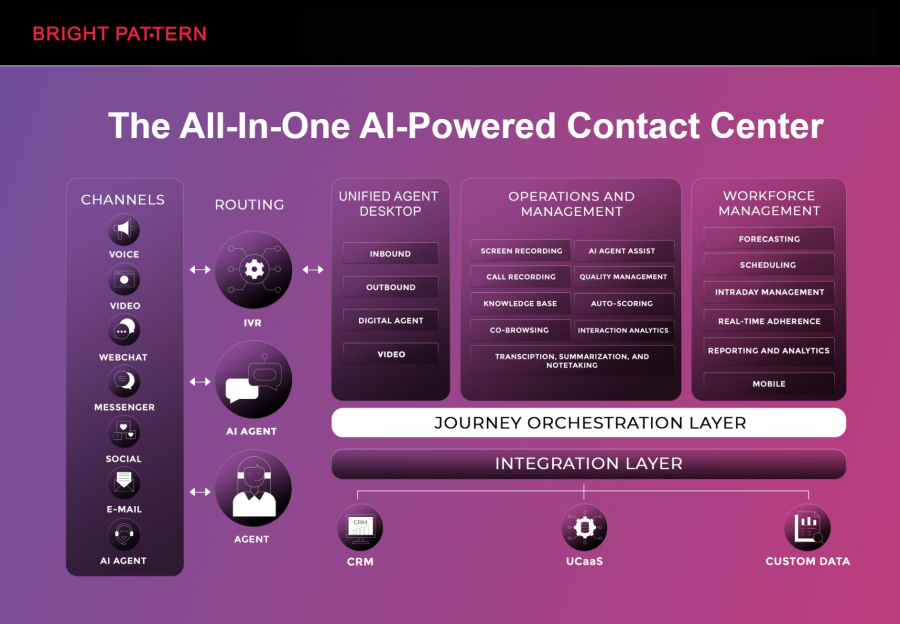
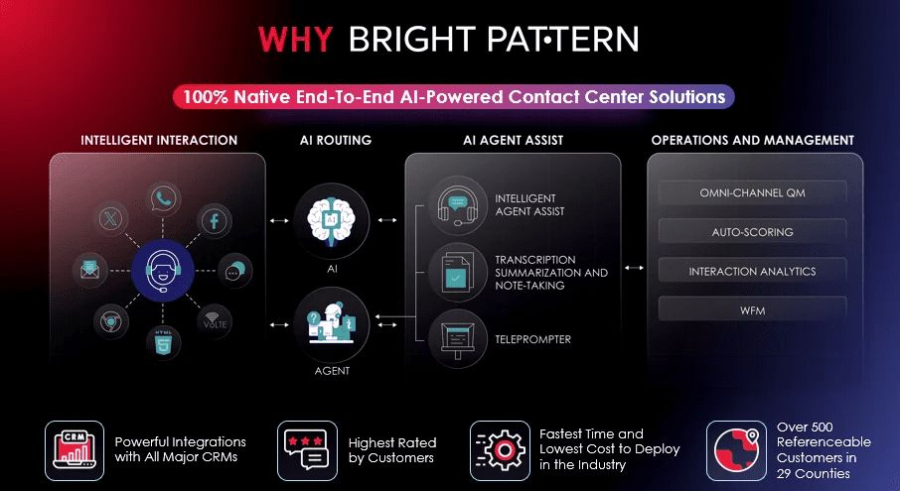
Bright Pattern is a comprehensive call center AI software designed for businesses of all sizes. Its cloud-based platform enables omnichannel support, intelligent routing, and AI-driven automation to enhance customer experience and streamline agent workflows.
Key features include:
- Omnichannel support across voice, chat, email, SMS, and social channels
- AI-guided agent assistance for faster, more accurate responses
- Smart routing based on customer history and preferences
- Advanced analytics and reporting for actionable insights
- Integration with CRM systems and third-party business tools
Bright Pattern’s platform helps businesses scale operations efficiently while maintaining a personalized customer experience. With AI-powered contact center solutions, agents are supported in real-time, allowing them to focus on solving complex issues rather than repetitive tasks.
2. Genesys Cloud CX
Genesys offers a robust AI-enabled contact center platform that delivers seamless customer engagement across channels. Features include predictive routing, virtual assistants, and detailed performance analytics.
3. Five9 Intelligent Cloud Contact Center
Five9 provides AI-enhanced cloud contact center solutions that improve agent efficiency with automation, omnichannel support, and customer sentiment analysis.
4. Talkdesk CX Cloud
Talkdesk combines AI tools with cloud technology to enhance customer interactions, optimize workflows, and provide real-time coaching to agents.
5. NICE inContact CXone
CXone offers AI-driven automation, predictive analytics, and multichannel support for businesses seeking to elevate their contact center performance.
6. RingCentral Contact Center
RingCentral integrates AI capabilities to support intelligent routing, automated responses, and detailed reporting for improved customer satisfaction.
7. Zendesk Suite
Zendesk’s contact center solution incorporates AI chatbots, workflow automation, and analytics to help businesses manage support efficiently across multiple channels.
8. 8x8 Contact Center
8x8 provides a cloud contact center platform with AI features like speech analytics, sentiment tracking, and automated workflows to enhance the customer experience.
9. Avaya OneCloud CCaaS
Avaya combines AI, cloud technology, and analytics to deliver scalable and efficient call center solutions suitable for enterprises and growing businesses.
10. Cisco Webex Contact Center
Cisco Webex integrates AI-powered self-service, automated routing, and analytics into its cloud contact center platform to improve agent performance and customer satisfaction.
What Is Call Center AI Software?
Call center AI softwareis a set of artificial intelligence tools designed specifically for customer service and contact center operations. It combines technologies such as natural language processing, speech recognition, machine learning, and automation to assist customers and agents before, during, and after every interaction.
Instead of relying only on human agents to answer every question, AI software can:
- Understand written or spoken customer questions in natural language.
- Provide automated responses where it is safe and appropriate to do so.
- Guide agents in real time with prompts, recommendations, and next best actions.
- Summarize conversations, update systems, and trigger workflows automatically.
The result is not a robotic customer experience. When implemented responsibly, call center AI creates a smoother, more human experience by freeing people to focus on empathy, judgment, and complex problem solving.
How Call Center AI Software Works
Modern call center AI solutions typically include a combination of the following capabilities:
- Natural language understanding (NLU)to interpret the meaning and intent behind a customer question, whether typed or spoken.
- Speech recognitionto convert phone conversations into text that AI systems can analyze in real time.
- Machine learning modelstrained on historical interactions, knowledge articles, and outcomes to recognize patterns and recommend answers.
- Automation and orchestrationto trigger workflows, update systems, and route cases without manual effort.
- Integrationsinto CRM, ticketing, telephony, and knowledge bases so AI has access to the context and data it needs.
Behind the scenes, AI models continuously learn from new interactions, feedback, and outcomes. Over time, the system becomes more accurate, more personalized, and more aligned with your business processes.
Key Benefits of Call Center AI Software
When deployed thoughtfully, call center AI software delivers advantages across the entire operation: customers, agents, supervisors, and leadership.
1. Faster, More Convenient Customer Service
Customers want answers without friction. AI helps you deliver:
- Instant responsesvia chatbots and virtual agents, 24 hours a day.
- Reduced wait timesin voice queues by solving simple issues automatically or assisting agents to resolve calls faster.
- Consistent answersbased on a single, AI-accessible knowledge source instead of scattered information.
This combination provides a more convenient, predictable experience for customers on every channel.
2. Lower Operating Costs Without Sacrificing Quality
AI allows contact centers to handle more interactions with the same or fewer resources, while keeping quality high. This is achieved through:
- Self-service deflectionof high-volume, low-complexity questions.
- Shorter handle timesthanks to automated data retrieval, suggestions, and summarization.
- More efficient staffingbecause AI can absorb volume spikes and repetitive tasks.
Instead of cutting corners, AI gives your team more bandwidth for situations where human care truly matters.
3. Happier, More Productive Agents
Repetitive questions and tedious after-call work are major sources of agent burnout. AI can dramatically improve the agent experience by:
- Eliminating mundane taskslike copying notes, updating fields, and searching through long documents.
- Providing real-time guidanceso newer agents feel supported and experienced agents can move even faster.
- Giving a single, intelligent workspacewhere relevant information appears automatically as they talk to customers.
Agents get to focus on solving problems, building rapport, and using their skills, which tends to improve engagement and retention.
4. Higher First-Contact Resolution
First-contact resolution is one of the most important drivers of customer satisfaction. Call center AI software boosts this metric by:
- Surfacing complete customer contextfrom past interactions, accounts, and systems in one place.
- Recommending next best actionsbased on what has worked in similar cases.
- Spotting hidden issuesthrough real-time analysis of customer sentiment and intent.
More issues get resolved on the first interaction, which makes customers and agents happier while avoiding costly callbacks.
5. Improved Compliance and Risk Management
Regulated industries and sensitive processes benefit from AI that quietly monitors and assists in the background. Specific advantages include:
- Real-time compliance promptsto remind agents about required disclosures or verification steps.
- Automated call summariesthat include key compliance checkpoints.
- Consistent policy adherenceby guiding agents toward approved language and actions.
This reduces the risk of human error while making audits and quality reviews more efficient.
6. Deep Operational Insights
Every interaction contains valuable data, but manual review limits what you can learn. AI removes that barrier by:
- Transcribing and analyzing 100 percent of calls and chatsinstead of a small sample.
- Identifying recurring issuesthat drive contacts, so you can fix the root cause.
- Spotting patterns in sentiment and behaviorto improve training, processes, and product design.
Leaders gain a much clearer view of customer needs and operational performance, enabling more confident decisions.
7. Seamless Omnichannel Experiences
Customers move between channels, and AI helps you keep everything connected. With a unified AI layer, you can:
- Recognize customersand their intent across voice, chat, email, and messaging.
- Carry context forwardso customers never have to repeat themselves.
- Provide consistent answersand policies on every channel.
Streamlined journeys translate into higher satisfaction and brand loyalty.
Core Features to Look For in Call Center AI Software
AI is a broad term, so it helps to break down the capabilities that matter most for a contact center. When evaluating solutions, consider whether they offer the following features.
1. Virtual Agents and Intelligent Chatbots
These are AI-powered assistants that interact directly with customers through voice or chat. Strong virtual agents typically provide:
- Natural language understandingso customers can speak or type freely instead of picking from rigid menus.
- Access to back-end systemsto check account details, update information, or perform transactions.
- Smart escalationthat routes complex issues to human agents with full context attached.
2. Real-Time Agent Assist
Agent assist tools act like a co-pilot for live agents. Look for capabilities such as:
- Live transcriptionof calls and chats.
- Suggested responsesbased on company-approved knowledge.
- Dynamic knowledge searchthat surfaces the most relevant articles as the conversation unfolds.
- Prompts for next stepstailored to the customer’s situation.
3. Automated Call and Chat Summarization
After every interaction, AI can generate concise summaries and update key fields. This feature helps you:
- Save agent timeand reduce after-call work.
- Standardize documentationso notes are clear and useful for follow-up.
- Feed analyticswith structured, consistent data.
4. AI-Powered Quality Management
Traditional quality monitoring relies on small samples. AI changes that with:
- Automated scoringof all interactions against defined criteria.
- Theme and sentiment detectionacross millions of conversations.
- Targeted coaching insightsthat highlight specific behaviors to reinforce or improve.
5. Intelligent Routing and Workforce Optimization
AI can match customers to the right resource, at the right time, using signals far beyond simple skills and queues. Strong platforms can:
- Predict customer needsbased on history, behavior, and intent.
- Route interactionsto the best-suited agent or bot.
- Support staffing decisionswith more accurate forecasts and real-time adjustments.
6. Robust Integrations and Data Connectivity
AI is only as good as the data it can access. Effective call center AI software should connect to:
- CRM systemsfor customer profiles and history.
- Ticketing and case managementfor full lifecycle visibility.
- Knowledge bases and documentationto fuel accurate answers.
- Telephony and contact center platformsfor real-time control of calls and routing.
The deeper and cleaner your data connections, the more value you get from AI.
Top Use Cases for Call Center AI Software
Every operation is unique, but many organizations start with a similar set of high-impact use cases.
1. Self-Service for Common Customer Questions
AI is ideal for handling high-volume, low-complexity issues, such as:
- Order status and tracking.
- Account balance or subscription information.
- Password resets and basic profile updates.
- Store hours, policies, and general information.
Virtual agents and chatbots can answer these questions quickly, escalate only when needed, and remain available around the clock.
2. Real-Time Support for Complex Calls
For more complex or sensitive interactions, AI assists agents rather than replacing them. Common scenarios include:
- Insurance claims or policy questions.
- Financial advice within defined guidelines.
- Technical troubleshooting and product support.
- Retention and win-back conversations.
By providing live prompts, knowledge suggestions, and process checklists, AI helps agents deliver confident, accurate answers without putting customers on hold.
3. Post-Interaction Automation
After calls and chats, AI can automate the parts of the process that consume agent time but add little customer value, for example:
- Drafting call summaries and customer notes.
- Updating case fields and disposition codes.
- Triggering follow-up workflows or notifications.
This shortens wrap-up time, improves data quality, and frees agents to move to the next customer quickly.
4. Voice of the Customer and Continuous Improvement
By analyzing every interaction, call center AI software uncovers trends and opportunities such as:
- Products or services that consistently confuse customers.
- Policy pain points that generate unnecessary contacts.
- Training gaps where agents struggle or make avoidable mistakes.
- Moments that delight customers and could be replicated more widely.
These insights feed a virtuous cycle of operational and experience improvements.
Step-by-Step: Implementing Call Center AI Successfully
AI projects succeed when they are business-led, thoughtfully scoped, and grounded in real operational needs. The following steps provide a practical roadmap.
1. Clarify Your Objectives
Before choosing technology, decide what success looks like. Common objectives include:
- Reducing average handle time.
- Increasing self-service rates.
- Improving first-contact resolution.
- Boosting customer satisfaction or net promoter scores.
- Enhancing compliance and reducing risk.
Clear goals make it easier to prioritize use cases, design metrics, and secure organizational support.
2. Identify High-Impact Use Cases
Not every process is a good candidate for AI on day one. Focus on use cases that are:
- Frequentenough to deliver meaningful impact.
- Structuredand governed by clear rules or policies.
- Low to medium riskso you can learn without exposing the business to major issues.
Examples include password resets, basic order inquiries, billing questions, or standard enrollment steps.
3. Prepare Your Data and Knowledge
AI performance depends heavily on the quality of your content and data. Investing time here pays off later. Key activities include:
- Ensuring your knowledge base is up to date, accurate, and not overly complex.
- Standardizing how you categorize interaction reasons and outcomes.
- Cleaning duplicate or conflicting information across systems.
A well-structured knowledge foundation makes AI responses more reliable and easier to govern.
4. Choose the Right Technology Partner
When evaluating call center AI software, look beyond features alone. Consider:
- How well it integrates with your existing telephony, CRM, and ticketing systems.
- The vendor’s experience with your industry and use cases.
- Governance and security capabilities, including data privacy controls.
- Ease of configuration, tuning, and ongoing management by your team.
The right platform should support your long-term roadmap, not just a single project.
5. Start Small, Then Expand
Begin with a pilot or limited rollout where you can measure impact clearly, such as:
- A specific queue or line of business.
- A defined set of intents for a chatbot or virtual agent.
- Real-time assist for a subset of agents or languages.
Monitor performance, gather feedback, refine, and then gradually extend AI capabilities across channels and teams.
6. Build Strong Governance
AI needs clear rules and oversight. Establish governance practices such as:
- Defining which tasks AI can handle independently and where human review is required.
- Creating approval workflows for knowledge content used by AI.
- Regularly reviewing AI behavior, accuracy, and escalation patterns.
Good governance keeps experiences safe, consistent, and on-brand.
Driving Agent Adoption and Trust
Agent buy-in is critical. When agents see AI as a supportive teammate rather than a threat, results improve significantly.
1. Communicate the Purpose Clearly
Explain early and often that AI is there to:
- Reduce repetitive work and administrative tasks.
- Help agents feel more confident in complex situations.
- Create opportunities for upskilling into higher-value roles.
Invite questions, address concerns openly, and involve agents in shaping how AI is used.
2. Provide Training and Hands-On Practice
Effective training should include:
- Short, focused sessions demonstrating how AI tools work in real interactions.
- Safe practice environments where agents can experiment without pressure.
- Guides or quick reference materials for new workflows.
As agents experience the time savings and support firsthand, adoption tends to grow quickly.
3. Use Feedback Loops
Frontline feedback helps you continuously improve AI performance. Build in mechanisms for agents to:
- Flag incorrect or unhelpful AI suggestions.
- Recommend new intents or knowledge articles.
- Share success stories where AI made a positive difference.
This turns agents into active partners in your AI journey and ensures the technology evolves with real needs.
Measuring Success: Key Metrics for Call Center AI
To understand the real impact of call center AI software, define clear metrics from the start and track them over time. Useful measures include:
Customer Experience Metrics
- Customer satisfaction scoresafter interactions handled or assisted by AI.
- First-contact resolution rateacross AI and human-assisted channels.
- Customer effort scoresto capture how easy it is to get help.
Operational Metrics
- Average handle timefor interactions with and without AI support.
- Self-service containment ratefor bots and virtual agents.
- After-call work timebefore and after automated summarization.
- Contact volume per agentand occupancy levels.
Quality and Compliance Metrics
- Quality scoresacross a larger sample of interactions.
- Compliance adherenceon scripts, disclosures, and verification steps.
- Error or rework ratesrelated to documentation and follow-up.
Combine quantitative data with qualitative feedback from customers and frontline staff to get a full picture of success.
The Future of Call Center AI
Call center AI is evolving rapidly, and emerging capabilities will open new opportunities for value creation. Key trends include:
- More natural, human-like conversationsas language models continue to improve.
- Richer personalizationusing deeper customer context while respecting privacy and consent.
- Stronger collaboration between humans and AIwhere tools anticipate agent needs and adapt to individual working styles.
- End-to-end journey optimizationas AI connects data across marketing, sales, and service touchpoints.
Organizations that invest early, build strong governance, and keep humans at the center will be well positioned to benefit from these advances.
Quick Checklist: Are You Ready for Call Center AI Software?
Use this checklist as a quick readiness assessment:
- You have clear business goals for AI in your contact center.
- Your knowledge and data sources are reasonably accurate and accessible.
- You have identified several high-volume, rule-based use cases.
- Leadership and frontline teams understand the vision and support it.
- You are prepared to start small, measure, and scale thoughtfully.
- Governance, privacy, and compliance requirements are defined.
If you can say yes to most of these points, you are in a strong position to unlock significant value with call center AI software.
Used thoughtfully, AI becomes a force multiplier for your contact center: elevating every interaction, empowering your agents, and turning customer service into a strategic advantage for your organization.
